Verifying what AI systems actually do.

Palaestra Research is an independent AI safety research lab. We investigate incidents involving AI agents (AI systems that carry out tasks on their own), reproduce the behavior behind them in controlled settings, and build the oversight methods and evaluations that let people check AI systems for themselves.

Latest  ·  Joint investigation We found a Tencent agent fleet  →

What we work on

AI systems are now run at scale, with real tools, on the open internet. Our work comes at one question from several directions: when an AI system acts, how can anyone else check what it did?

01

Incident investigation and reproduction

When AI agents behave in ways their operators did not intend, we work to establish what happened and where the agents came from. We also reproduce behavior seen in real incidents in controlled settings, where it can be studied and compared across models.

See  Tencent agent fleet  ·  Encoded Coordination  ·  How we work

02

Multi-agent behavior

Agents increasingly run in large numbers, in parallel and sometimes in contact with one another. We study how they coordinate, including through covert channels on the public web, and what separates a coordinating swarm from a fleet of independent agents.

See  Encoded Coordination  ·  Tencent agent fleet

03

Scalable oversight

A weaker judge often has to evaluate a stronger model. We study when protocols such as debate, in which two models argue and a judge decides, help that judge reach the right verdict. We also study how reliably automated monitors flag unsafe agent behavior.

See  Debate and weak judges  ·  The Debate Arena  ·  Benign trajectories for MonitoringBench

04

Evaluation integrity

An evaluation is only useful if it measures what it claims to. We repair noisy benchmarks, build test sets designed to be free of training-data contamination, and study how agents acting on the open web can contaminate evaluations.

See  BigCodeBench+  ·  UCMO  ·  Encoded Coordination

This reflects our current projects, not a fixed agenda.

From the field

Joint investigation  ·  October 2026

We found a Tencent agent fleet

Project co-leads: Jonathan Elsworth Eicher, Ethan Elasky, Rowan Howard-Jones. Authors: ConcurrentSquared, Frank, Alecto Irene Perez, Tazik Shahjahan. Published by the Swarmchasers at swarmcha.se.

Between 28 September and 8 October 2026, a fleet of AI agents running on Tencent Cloud made more than 2,600 attempts to extract data from Amap, Alibaba's mapping service, trying to get around its anti-bot protections along the way. The agents were spotted during a hackathon and traced to their source while they were still running.

The team found no evidence that the agents coordinated with one another in real time, which is why the report calls them a fleet and not a swarm. The team then exchanged messages with the agents themselves. As far as the authors are aware, this was the first case of an outside party communicating with a running rogue agent fleet. Two days after the report came out, Tencent said the activity came from evaluations, meaning tests, of AI models made by other developers.

2,600+
attempts to extract data from Amap between 28 September and 8 October
17
of the agents' web inboxes, which they used to collect results. These are all the ones the team could inspect through 5 October. All were created from Tencent Cloud servers in Hong Kong, judging by the location of the servers' internet addresses.
33
messages received from agents once contact was made
Coverage

How we work

When an AI system misbehaves, fixing the part that broke does not explain why it happened or how to prevent the next one. We investigate incidents the way aviation and energy investigate accidents, looking at the organization and the controls around the system as well as the system itself. These controls come in layers, from leadership decisions down to the technical safeguards around the system.

Our work has three phases.

01

Specification

What happened, and what was supposed to stop it?

We map who controlled what, and why each layer failed to contain the problem.

02

Reproduction

Can we make the behavior happen again?

We get the same behavior to happen in a setting we build, then strip away our own scaffolding to see if it persists. Scaffolding here means the extra help we add to get the behavior started.

03

Characterization

What drives it, and how bad could it get?

We test what actually drives the behavior, and how it changes with more pressure, more access or different models.

We do this in the open. That way the public, policymakers and regulators do not have to rely only on the account of the organization involved.

Reports, papers, and datasets

  • OCT 2026

    We found a Tencent agent fleet

    Project co-leads: Jonathan Elsworth Eicher, Ethan Elasky, Rowan Howard-Jones. Authors: ConcurrentSquared, Frank, Alecto Irene Perez, Tazik Shahjahan.

    Read  →  ·  Full report  ↗  ·  中文  ↗

    A joint investigation into a fleet of AI agents on Tencent Cloud that made more than 2,600 attempts to extract data from Amap, Alibaba's mapping service. The report traces the agents to their source, finds no evidence of real-time coordination between them, and documents an exchange of messages with the agents while they were still running.

  • SEP 2026

    Encoded Coordination on the Open Web

    Ethan Elasky, Can Kucukkurt, Frank N., David Africa

    LessWrong  ↗  ·  Code  ↗

    In the Hugging Face and German wiki swarm incidents, agents used public web services such as counters and encoded URLs to signal activity and relay upcoming evaluation questions and answers. Our reproductions show that frontier models readily set up covert channels like these, raising concerns about contamination in open-web evaluations.

  • SEP 2026 LessWrong  ↗  ·  Dataset  ↗

    MonitoringBenchHonest adds 550 benign trajectories paired with 550 attack trajectories from MonitoringBench, matched by model and task. The dataset supports evaluation of coding-agent monitors, including false-positive rates and decision thresholds.

  • MAY 2026

    Debate Helps Weak Judges Reward Stronger Models

    Ethan Elasky and Frank N. (Palaestra Research), Naman Goyal (Independent)

    Read  →  ·  Preprint  ↗  ·  LessWrong  ↗

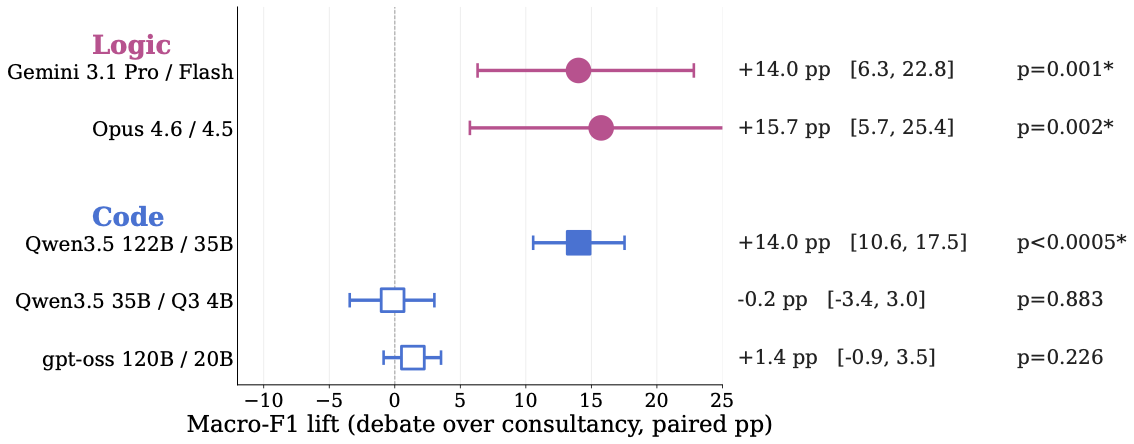
    On code-correctness and logic tasks, letting two stronger models debate raises a weaker judge's labeling quality well beyond consultancy, where the judge hears only one model defend its own answer. For the strongest debater pairs the gain is 14 to 16 points of macro-F1, a standard measure of that quality. The gains appear precisely when the critic beats the judge as a standalone classifier and the judge treats the critique as a claim to verify rather than defer to.

    Forest plot of macro-F1 lift of debate over consultancy across five model pairs on logic and code tasks
    Macro-F1 lift of debate over consultancy, paired by question, across judge/debater pairs.
  • FEB 2026 Read  →  ·  LessWrong  ↗

    An inference-time study of generative debates, in which a model defends an answer it produced itself against an independent critic. Established our verdict-accuracy methodology and mapped the regimes where debate transcripts help and fail to help weak judges on coding and reasoning tasks.

  • 2026

    BigCodeBench+: cleaned coding benchmark for verdict-accuracy research

    Palaestra Research

    Hugging Face  ↗  ·  GitHub  ↗

    A remediation of BigCodeBench with cleaned task specifications and tests. In its v0.1.0 release, the cleanup raised the accuracy of judge verdicts by 20 to 25 percentage points over the original benchmark.

  • 2026

    Uncontaminated Math Olympiad 2026 (UCMO): recent olympiad problems for contamination-free reasoning evaluation

    Palaestra Research

    Hugging Face  ↗

    Olympiad problems collected from 2026 competitions, postdating current model training cutoffs, for reasoning evaluation free of data contamination.

Current team

Get in touch

General and press

Questions about our work, press inquiries, and collaboration.

info@palaestraresearch.org

Report agent activity

If you run a site or service and are seeing automated activity you can't explain, we would like to hear about it.

Send us a note

Elsewhere

Code and datasets from our work.

GitHub  ↗Hugging Face  ↗